Published on 31 Jan 2026
5 min Read
Building Production-Grade Product Attribute Extraction at Scale
The Agentic AI to Automate Construction Document Understanding

Bindu Achalla
AI Scientist
Every large e-commerce platform faces the same invisible problem: product data chaos.
The same item can appear with ten different descriptions, missing attributes, or inconsistent measurements, breaking filters, search results, and customer trust. Our team set out to solve this by building a system that can understand and standardize product information at scale, turning raw catalog text into structured, reliable data in minutes.
When launching a new marketplace or adding a new product category, identifying which attributes truly define a product is slow, manual work. Teams spend weeks deciding what matters most for that category, how it should be presented to customers, and how to align vendor data with that structure. Each expansion becomes a repetitive exercise in discovery and reformatting, delaying launches and creating inconsistencies across catalogs.
Using ChatGPT or other large language models might seem like a quick fix, but they don’t scale reliably. They handle small batches well but lose consistency and context as data volume grows, hitting token limits, generating unpredictable outputs, and driving up cost. What works for a few listings doesn’t work for millions.
We needed something more adaptive; an agentic system that could reason, verify, and coordinate multiple steps automatically. Instead of one model trying to do everything, our pipeline orchestrates specialized agents for extraction, validation, and ranking, ensuring accuracy, stability, and scalability across diverse product catalogs.
The Challenge We Addressed
Modern product catalogs are massive, dynamic, and inconsistent. Every supplier formats data differently. One lists “Height: 16 inches,” another writes “Ht = 16 in,” and a third omits the dimension entirely. Multiply that by thousands of vendors and millions of SKUs, and a simple search filter like Height > 10 inches can fail across an entire marketplace. The result is lost discoverability, inaccurate listings, and frustrated customers.
Traditional rule-based systems can’t keep up. Hand-curated mappings and regex pipelines require constant updates and still miss the long-tail edge cases that appear daily. Manual cleanup teams face overwhelming workloads, while automated scripts often break when vendors change formatting or terminology.
Even advanced large language models like ChatGPT-5, though capable of understanding context, were never designed for production-scale catalog management. They handle small batches well but struggle when processing hundreds of products simultaneously, hitting context limits, inconsistent structure, and variable latency. For platforms operating at millions of SKUs, these inefficiencies quickly translate into higher operational costs, poor product visibility, and lower conversion rates.
Our Solution: A Production-Grade LLM Pipeline
To fix this, we built a pipeline that treats every product like a small story waiting to be understood, not just parsed. When a new catalog arrives, the system reads each item’s title, description, and specifications, extracting clues about what it actually is. Take a listing like:
Goodman GLXS4BA2410+CAPTA2422A3+GR9S960403BU 2 Ton Air Conditioner, Coil System, Furnace Upflow/Horizontal.
Instead of viewing this as a block of text, our pipeline recognizes that it describes three distinct components: an outdoor unit, a coil, and a furnace. Each with its own attributes, such as capacity, refrigerant type, and configuration.
From that single input, the framework begins a structured process:
Extraction: A tuned LLM reads descriptions and identifies all possible attributes and values.
Category-aware logic: It adapts terminology to the product’s domain, ensuring “Filter Height” and “Fan Height” both map meaningfully but differently.
Parallel batch processing: Dozens of products are analyzed simultaneously, allowing throughput to scale from hundreds to over a million SKUs without overwhelming memory or context limits.
Smart validation: The system automatically cross-checks detected values, avoiding duplication or noise while retaining edge-case details.
Attribute ranking and selection: Finally, it prioritizes the most informative fields for left-navigation filters, ensuring that buyers always see dimensions, brand, and key performance metrics first.
The result is a production-grade pipeline that combines the interpretive power of LLMs with the discipline of distributed data processing. It doesn’t just extract text; it reconstructs structured knowledge from unstructured catalogs, delivering standardized, filter-ready product attributes with high precision and minimal manual intervention.
From Prototype to Production Scale
When we first benchmarked the pipeline against ChatGPT-5 on 100 products, the differences were striking.
The baseline LLM could identify attributes correctly in small samples, but it stalled as data volume grew, losing recall, consistency, and speed. Our new pipeline maintained precision while scaling effortlessly from hundreds to 1.79 million products, without exceeding 8 GB of memory.
Metric | ChatGPT-5 | Dynamic Attribute Pipeline | Improvement |
|---|---|---|---|
Avg. Confidence | 0.84 | 0.93 | +11 % |
Precision | 0.85 | 0.93 | +9 % |
Recall | 0.70 | 0.88 | +26 % |
F1 Score | 0.77 | 0.92 | +19 % |
Normalization Accuracy | 0.65 | 0.90 | +38 % |
Value Accuracy | 0.60 | 0.88 | +47 % |
Throughput | 50 SKUs / min | 170 SKUs / min | ×3.4 |
Memory Use | 120 GB | 8 GB | –93 % |
Total Time (1.79 M SKUs) | ~300 hrs | ≈ 3 hrs | –99 % |
What matters most isn’t just the numbers; it’s the experience they unlock.
Retailers can now refresh entire catalogs overnight instead of quarterly.
Merchants see their products surface correctly in search and filters within hours of upload.
Data teams gain confidence that every new attribute added by a vendor will be interpreted consistently across millions of listings.
In production tests, the pipeline handled categories with complex multi-component bundles (like HVAC systems or toolkits) as smoothly as simple single-SKU items. Its distributed design ensures that each worker processes products independently, meaning no bottlenecks — even when the catalog count or attribute density spikes.
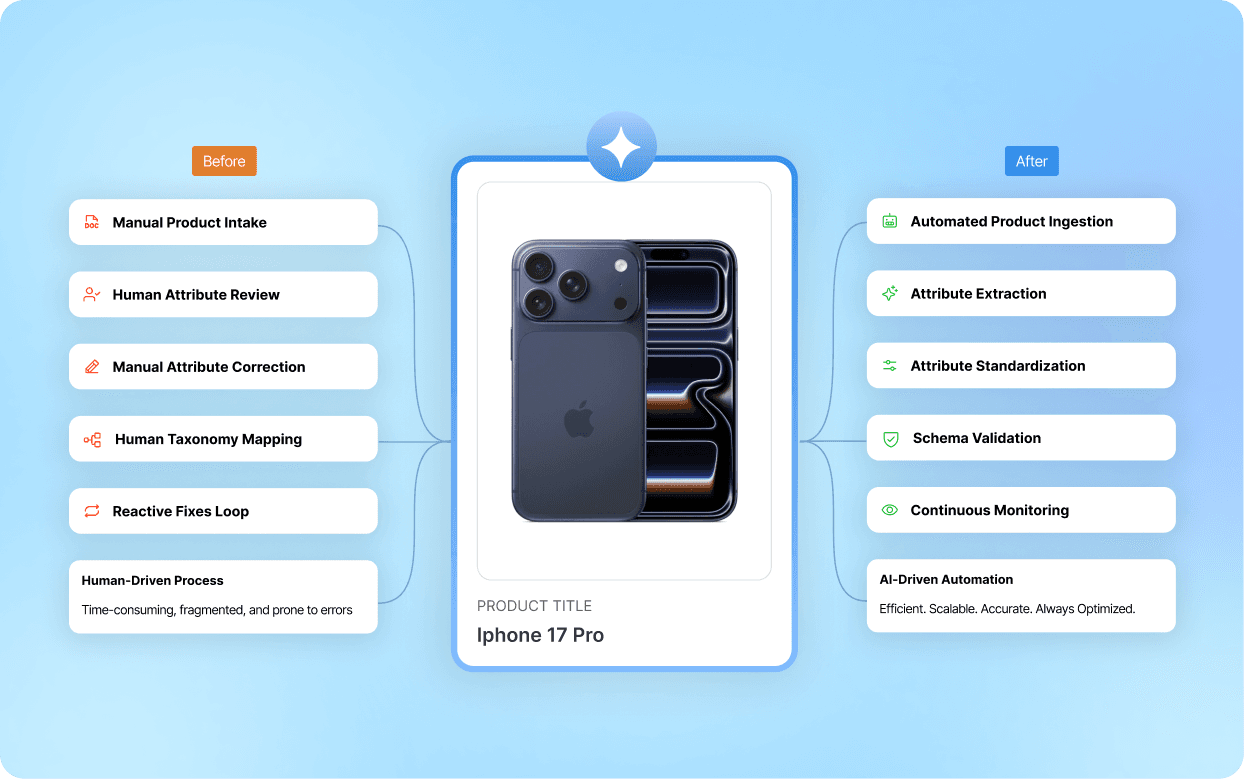
This shift from manual cleanup and one-off LLM calls to a continuously running, self-orchestrated pipeline marks a step change in how product data can be managed at scale.
Behind the scenes, the pipeline’s reliability comes from thousands of small engineering choices; resilient workflows, category-aware mapping, and intelligent parallelization, all tuned for scale. This isn’t just a smarter model; it’s a smarter system.
Why It Matters
Clean, consistent product data is the foundation of every great e-commerce experience. With this pipeline, retailers no longer need to choose between accuracy and speed; they get both.
For merchandising teams, it means entire catalogs can be refreshed overnight instead of painstakingly over weeks. Attributes like dimensions, brand, and energy rating appear exactly where shoppers expect them, restoring trust in product filters and comparisons. Vendors, meanwhile, see their listings surface correctly across marketplaces without endless data-format adjustments or manual review cycles.
The impact compounds quickly: better search results, higher click-through rates, and a measurable lift in product discoverability. Internally, the same data becomes far easier to analyze, enabling pricing insights, trend detection, and quality control without additional cleanup.
By automating what once required hours of manual curation, the Dynamic Attribute Extraction Pipeline doesn’t just make product data cleaner — it makes commerce faster, smarter, and infinitely more scalable.
This work reflects our broader vision: to bring structure, intelligence, and scale to how businesses manage their data. Future releases will continue to expand category coverage, improve processing efficiency, and integrate feedback loops that make every run smarter than the last.
Want to see the pipeline in action? Reach out to our data team for a walkthrough of how we scale attribute extraction across millions of SKUs with precision and speed.
COMING SOON